
Why We Log PSI, Media, Time, and Results
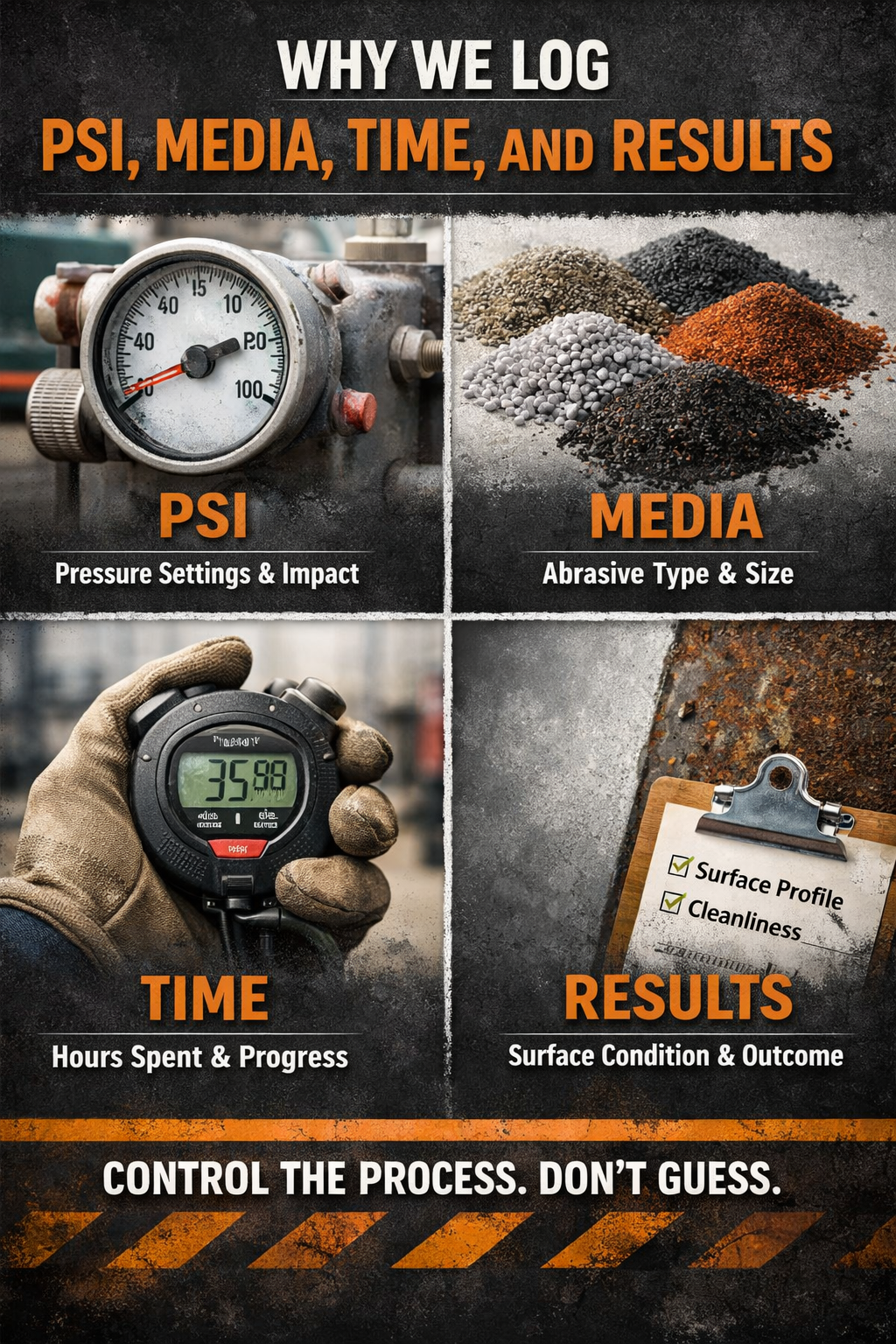
Most people think blasting is about pulling the trigger and removing material. In reality, it’s a controlled process with a lot of variables. When something goes right or wrong, the reason is almost always hiding in one of four places: pressure, media, time, or outcome.
That’s why we log them.
Not for paperwork. Not for appearances. For cause and effect.
PSI Tells Us How Aggressive the Process Really Was
PSI is not just a setting. It is a behavior.
Higher pressure means:
more impact energy
faster removal
higher risk of over-profiling
higher risk of warping thin material
Lower pressure means:
slower removal
more passes required
higher chance of under-cleaning
better control on delicate substrates
If a surface fails later and we don’t know the pressure used, we’re guessing. If we do know it, we can ask better questions: was it too much for the coating system, or not enough for the rust grade?
PSI connects machine behavior to surface condition.
Media Choice Explains Surface Texture
Media is not interchangeable.
Crushed glass, coal slag, garnet, soda, and specialty abrasives all fracture differently and leave different textures behind. Even the same media behaves differently depending on mesh size and moisture.
Logging media lets us track:
how aggressive removal was
what profile was created
how much material was consumed
how predictable the result was
When a coating performs well, we want to know what combination created that result. When it fails, we want to know what surface texture it was bonded to.
Without media records, surface prep becomes folklore instead of repeatable work.
Time Shows Where the Job Actually Lived
Time is the most honest variable.
It shows:
how hard the coating really was
how much detail work existed
how long setup and cleanup took
where productivity dropped
Two jobs can look the same on paper and behave completely differently in the field. Time exposes that difference.
Logging time helps us:
price future jobs realistically
recognize coatings that are unusually difficult
understand when access or geometry is slowing work
separate equipment limits from material limits
It turns estimates into data instead of optimism.
Results Close the Loop
Results are what the customer actually gets.
That includes:
visual cleanliness
surface profile
consistency
how the coating performs later
Without tying results back to PSI, media, and time, we can’t learn from them. We can only react to them.
When a job holds up well, logging lets us see what combination worked. When something fails, logging lets us see what conditions were present.
This is how experience becomes transferable instead of trapped in someone’s head.
Why This Matters for Customers
Customers rarely care what PSI was used. What they care about is:
whether the coating lasts
whether the asset performs
whether rework is needed
Logging protects them from repeat mistakes.
It means:
future jobs benefit from past outcomes
surface prep becomes more consistent
surprises become less frequent
It’s one of the quiet ways professionalism shows up without being visible.
Why This Matters for Blasters
Blasting is easy to do and hard to do predictably.
Logging turns:
one-off jobs into reference points
gut feelings into patterns
mistakes into information
It also protects blasters when questions come later. Being able to say what conditions were used is different than saying “we blasted it like we always do.”
Consistency is built from records, not memory.
The Difference Between Guessing and Controlling
When surface prep is not logged, problems get blamed on:
paint
weather
steel quality
bad luck
Sometimes that’s true. Often it isn’t.
When surface prep is logged, you can see:
whether pressure matched the surface
whether media matched the coating
whether time matched the condition
whether results matched expectations
That’s the difference between guessing and controlling the process.
Final Thought
Logging PSI, media, time, and results is not about micromanaging. It’s about understanding what actually happened.
Blasting is physical. Coatings are chemical. Failures live in the gap between the two. Records are how that gap gets smaller instead of wider.
Next up: Blasting Trailers: What Blasters Actually Consider When Pricing
