
How Surface Prep Affects Paint Warranty
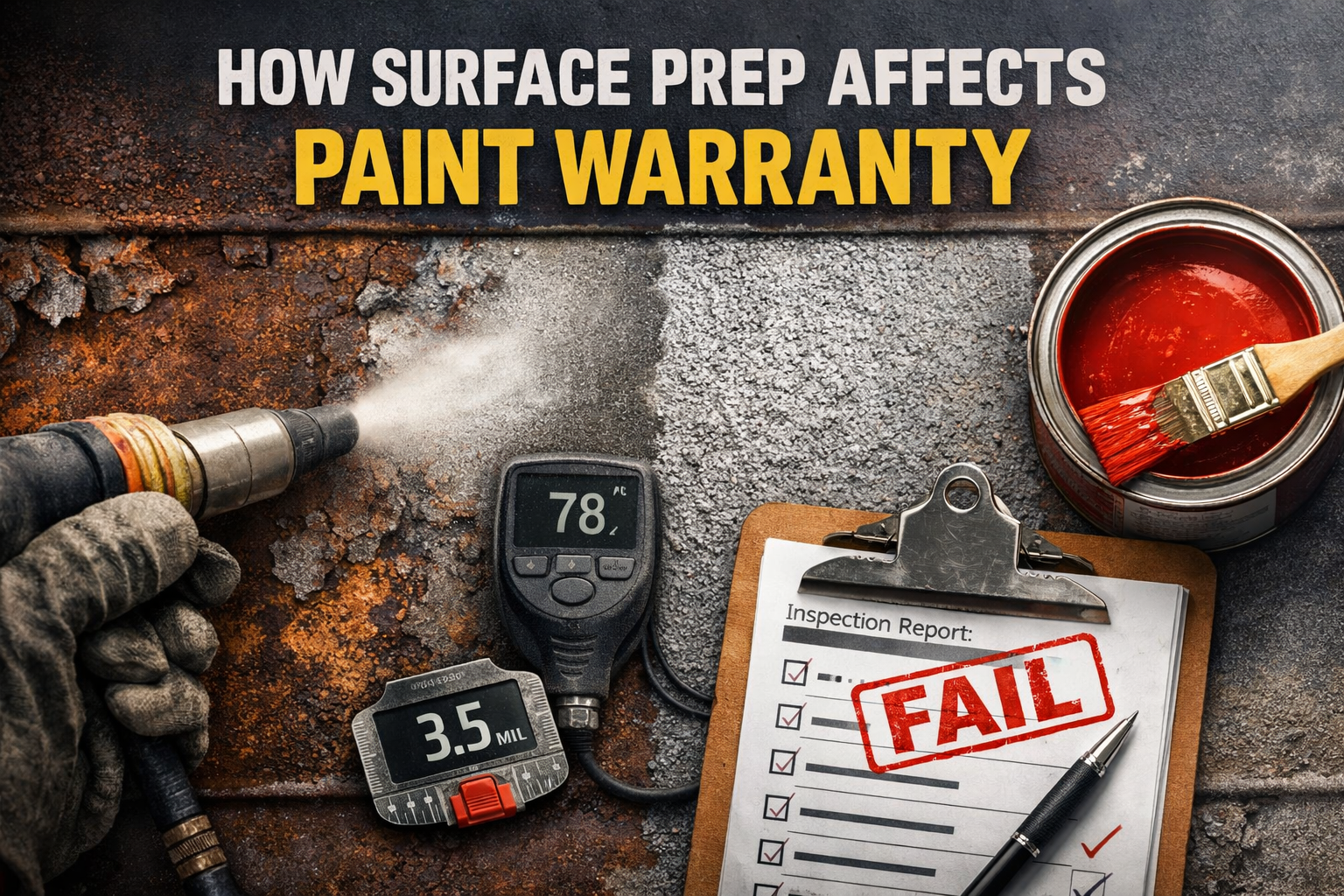
Paint warranties sound simple.
Apply the product correctly and the manufacturer stands behind it.
In reality, most coating warranties are quietly decided before the paint ever leaves the can.
They are decided by surface preparation.
Not by the painter.
Not by the brand.
Not by the thickness of the coating.
By what the metal looked like and felt like when the first layer went on.
What Paint Warranties Actually Cover
Most paint warranties do not guarantee that paint will stick.
They guarantee that the coating will perform if the surface meets specific preparation standards.
Those standards usually include:
Cleanliness level
Rust removal level
Surface profile
Environmental conditions
Application method
Dry film thickness
If any one of those is off, the warranty becomes conditional.
That means when failure happens, the first question is not “Was this paint bad?”
It is “Was the surface prepared correctly?”
Why Manufacturers Care More About Prep Than Paint
Paint fails in predictable ways.
Peeling.
Blistering.
Underfilm rust.
Delamination.
Almost all of those failure modes start at the interface between steel and coating.
That interface is created by surface preparation.
If:
contaminants remain
rust is left behind
the profile is wrong
moisture is trapped
flash rust forms
or oil is driven into the steel
the coating never fully bonds.
The paint can be perfect.
The failure still starts underneath.
Clean Metal Is Not the Same as Prepared Metal
This is where most warranty problems start.
Metal can look clean and still fail inspection.
A pressure washed surface can be free of dirt but still be:
too smooth
chemically contaminated
polished instead of profiled
holding moisture
covered in invisible salts
From a warranty standpoint, “clean” does not matter.
Only prepared matters.
That usually means:
defined rust removal level
controlled surface profile
dry and oil free
within temperature and dew point limits
If those are not met, the coating system is already compromised.
Surface Profile Is a Warranty Trigger
Most industrial coatings require a mechanical bond.
They do not glue themselves to steel.
They lock into microscopic peaks and valleys created by blasting.
If the profile is:
too shallow, the coating sits on top
too deep, the coating bridges over voids
inconsistent, adhesion varies across the surface
Warranties often specify:
target profile range
acceptable variance
measurement method
If no profile readings exist, there is no proof the surface met spec.
Which means there is no proof the warranty applies.
Timing Matters More Than People Think
Even perfect prep has an expiration date.
Bare steel begins reacting with air and moisture immediately.
That reaction shows up as:
flash rust
oxide film
moisture condensation
salt migration
If coating is delayed:
hours in humid air
overnight with dew
during temperature swings
the surface changes.
Not visibly at first.
But chemically.
From a warranty standpoint, that change breaks continuity between prep and coating.
That is why many specs require:
coating within a set window
re-blasting if delayed
climate control or inhibitors
It is not bureaucracy.
It is physics.
Documentation Is Part of the Warranty
Manufacturers rarely deny warranties based on opinion.
They deny them based on missing proof.
Typical documentation includes:
surface prep standard used
profile measurements
environmental readings
blast method
coating thickness
cure times
If none of that exists, the warranty becomes hard to defend.
Not because the job was bad.
Because it cannot be proven good.
Surface prep is invisible after coating.
Documentation is the only record it ever happened.
Where Most Warranties Quietly Fail
Not at the paint stage.
They fail when:
prep is rushed
specs are guessed
moisture is ignored
surfaces are “close enough”
profile is assumed
timing slips
or conditions change
Each one weakens the bond.
And when failure appears months later, the root cause is almost always underneath.
What This Means for Owners and Contractors
For owners, surface prep controls:
how long coatings last
whether warranties apply
whether repainting is early or expected
For contractors, it controls:
liability
callbacks
reputation
rework
For both, it determines whether the coating system is working as designed or just looking good for a while.
Final Thought
Paint warranties are not decided by paint.
They are decided by preparation.
Once coating starts, the outcome is already locked in.
Next up: The Future of Surface Prep (Lasers, Robotics, AI)
