
The Future of Surface Prep (Lasers, Robotics, and AI)
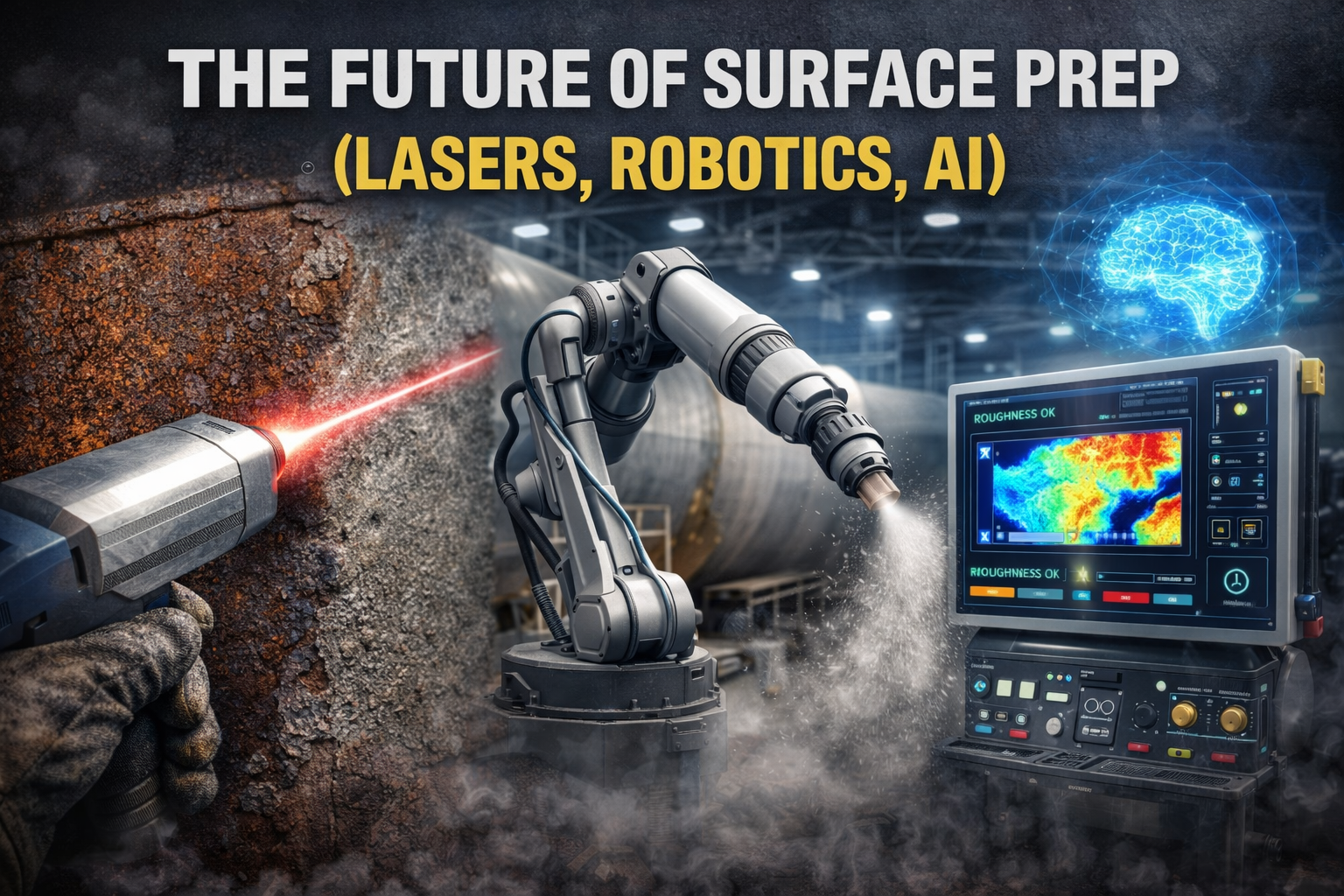
Surface preparation has always been physical work. Steel, grit, air, pressure, and time. But the tools around that work are changing fast. Not in a “sci-fi tomorrow” way, but in quiet, practical steps that are already showing up on real jobs.
Lasers. Robots. AI.
None of them replace blasting outright. But each one changes where blasting fits in the process.
This isn’t about hype. It’s about what’s actually starting to work, what still doesn’t, and what that means for how surfaces get prepared over the next decade.
Lasers: Precise, Clean, and Narrow
Laser cleaning is already being used in aerospace, electronics, and some specialty industrial work. The appeal is obvious:
No abrasive media
No dust
No secondary waste
Very controlled removal
A laser can remove paint, rust, or contaminants by vaporizing them layer by layer. It’s surgical. It’s clean. And it looks impressive.
But it has limits.
Lasers are slow compared to blasting.
They struggle with heavy scale and thick coatings.
And most importantly, they do not naturally create a surface profile the way abrasive impact does.
That matters because coatings still need mechanical bite. A clean surface without profile is not automatically a paint-ready surface.
Where lasers make sense:
Thin coatings
Precision parts
Sensitive substrates
Enclosed or high-regulation environments
Where blasting still wins:
Large steel
Heavy corrosion
Thick industrial coatings
Jobs that need measurable profile
Lasers don’t replace blasting. They replace certain kinds of blasting.
That distinction matters.
Robotics: Removing People from the Worst Parts
Robotic surface prep isn’t new. Shipyards and tank farms have used crawlers and automated blasting arms for years. What’s changing is cost and control.
Modern systems can:
Hold consistent nozzle distance
Maintain fixed angles
Log speed and coverage
Work longer without fatigue
The benefit is not just labor savings. It’s consistency.
Humans vary. Robots don’t.
But robots introduce new constraints:
Setup time
Power and control requirements
Surface geometry limitations
High upfront cost
A robot works best on:
Flat steel
Tanks
Hulls
Repeating structures
It struggles with:
Complex geometry
Tight corners
Field improvisation
Small one-off jobs
For now, robotics shifts who does the blasting more than how blasting works. The physics of surface prep stay the same. The delivery method changes.
AI: Controlling the Process, Not the Steel
AI isn’t blasting anything. It’s managing it.
The real use case is optimization and documentation:
Monitoring air pressure and flow
Tracking nozzle wear
Flagging inconsistent passes
Predicting media consumption
Detecting surface condition changes
Think of it as a smarter foreman, not a new blaster.
AI systems can already:
Identify coating defects from images
Measure roughness digitally
Compare results against spec
Build repeatable profiles
This changes two things:
How jobs are documented
How mistakes get caught
Instead of discovering failure after coating, future systems catch prep issues in real time.
That’s a major shift.
What Doesn’t Change
No matter how advanced the tools get, certain truths remain stubborn:
Coatings still need profile
Rust still spreads under paint
Moisture still causes flash rust
Steel still reacts with oxygen
Specs still fail when rushed
Lasers don’t change chemistry.
Robots don’t change corrosion.
AI doesn’t change adhesion physics.
Surface prep still determines coating life. The tools just get better at delivering or verifying it.
Where This Breaks Down
New tech tends to break in the same places:
Outdoor environments
Irregular shapes
Dirty substrates
Tight schedules
Mixed materials
Blasting is forgiving.
Lasers are not.
Robots want ideal conditions.
Field work rarely provides them.
For most real-world projects, the future is hybrid:
Blast the heavy stuff
Laser the sensitive areas
Robotize the repetitive sections
Let software watch the process
Not replacement. Integration.
What This Means for Contractors and Owners
For contractors, it means:
Equipment decisions will be strategic, not just operational
Documentation will matter more
Consistency will matter more
Training will matter more
For owners, it means:
Fewer excuses for bad prep
Better traceability
More predictable performance
Higher expectations
The surface doesn’t care how it was cleaned.
The coating only cares whether the prep was right.
Final Thought
Blasting built the foundation of modern coatings. That doesn’t disappear.
What changes is how controlled, measured, and verified surface prep becomes.
Lasers remove.
Robots repeat.
AI watches.
Blasting still prepares.
