
Blasting Heavy Equipment: Hidden Time Traps
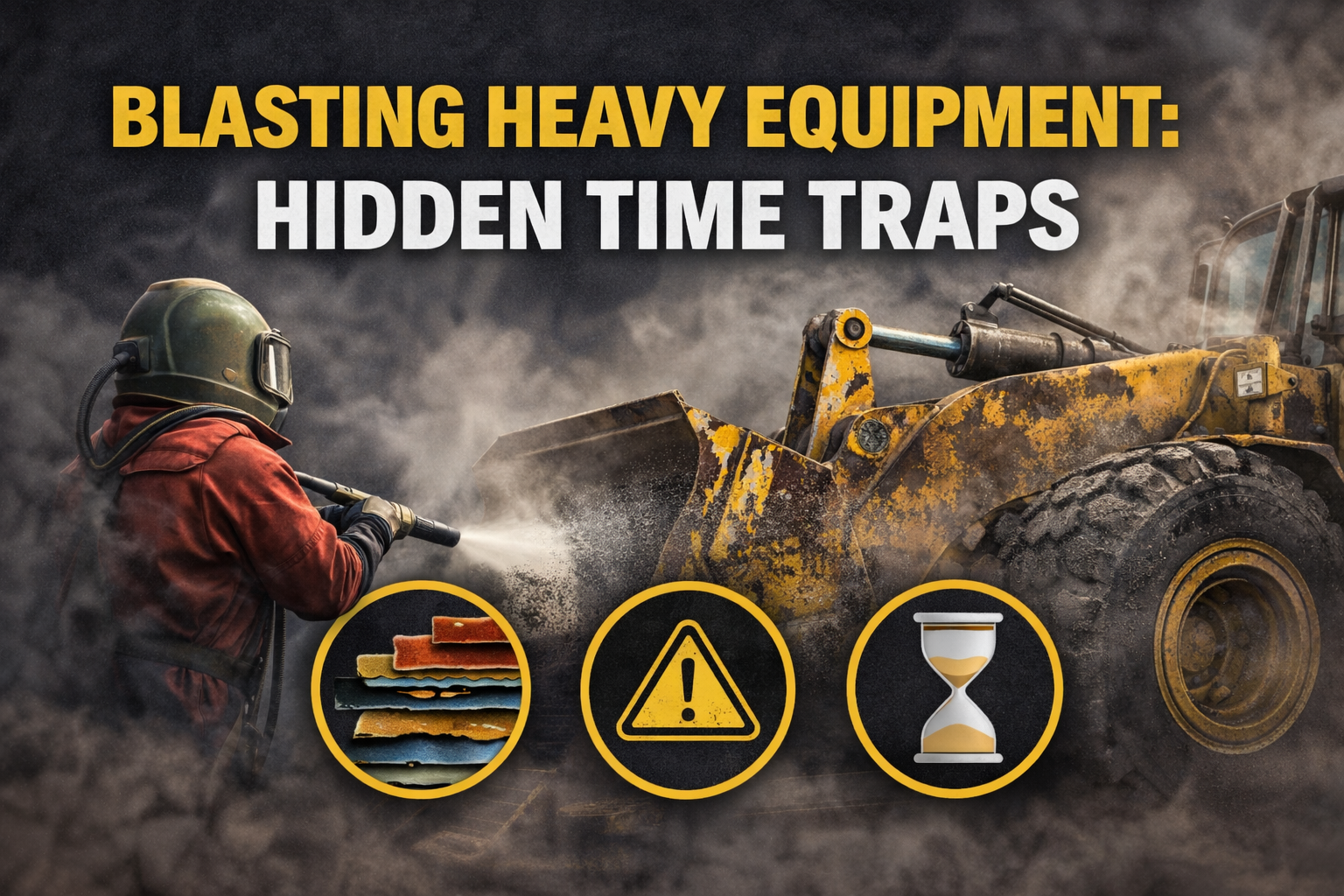
Heavy equipment looks simple on paper. Big steel. Thick paint. Built to take abuse.
In reality, it is one of the easiest ways to lose time on a blasting job.
Not because blasting is slow.
Because heavy equipment hides work in places no one budgets for.
Most schedule overruns are not caused by the blaster.
They are caused by what the blaster discovers once blasting starts.
Old Coatings Stack Up
Heavy equipment rarely has one coating system.
It usually has:
factory primer
multiple repaints
touch-up zones
grease-stained layers
rust creeping under paint
Each layer behaves differently under abrasive.
Some coatings fracture clean.
Some smear.
Some soften with heat.
Some take two or three passes to remove.
What looked like a single strip pass becomes a multi-stage removal job.
This is one of the most common time traps.
Geometry That Slows Production
Heavy equipment is not flat.
It has:
ribs and stiffeners
brackets and gussets
overlapping steel
recessed bolt heads
hydraulic mounts
tight corners
Blasting is fastest when the nozzle hits square to the surface.
Equipment rarely allows that.
Every angle change:
reduces impact energy
increases dwell time
increases media consumption
Flat tank walls blast fast.
Loader frames do not.
The shape alone can double the time.
Grease Is a Blasting Killer
Heavy equipment is designed to be lubricated constantly.
That means:
grease on joints
oil film on frames
hydraulic mist on steel
Abrasive does not remove grease well.
It just spreads it.
Greasy steel:
clogs media
smears paint
blocks profile formation
creates rework
If degreasing is skipped or underestimated, blasting slows to a crawl.
This is a hidden trap because grease is not always visible until abrasive hits it.
Welds Take Longer Than Plate
Heavy equipment has a lot of weld metal.
Welds:
are harder than plate
have uneven surface
trap paint in valleys
collect corrosion at toes
They do not blast at the same rate as flat steel.
If a job is estimated by square footage alone, weld density gets ignored.
That mistake shows up in time.
Two machines with the same surface area can blast very differently depending on weld count.
Pitting Multiplies Effort
Rust on equipment is rarely uniform.
You often see:
deep pitting under paint
flaking scale near joints
smooth steel on outer panels
Pitted steel:
takes longer to clean
traps abrasive
hides corrosion
needs slower passes
What looks like “moderate rust” can behave like severe rust once exposed.
This is another time trap that only appears mid-job.
Access Is Never As Good As It Looks
On paper, equipment looks easy to reach.
In reality:
hoses block panels
guards limit reach
wheels block frames
undercarriages restrict angles
You cannot blast what you cannot reach.
Every reposition:
takes time
changes setup
resets containment
increases labor
If access is limited, production drops no matter how powerful the machine is.
Containment Takes Over the Clock
Heavy equipment is often blasted:
in yards
near other assets
in public or active sites
Containment can take longer than blasting.
It must account for:
overspray
dust drift
runoff
debris
nearby workers
On equipment, containment is rarely simple rectangles.
It has to wrap around irregular shapes.
This is time no one sees until it is needed.
Rework Is the Quiet Killer
Equipment jobs often include:
missed spots
shadowed corners
inaccessible areas
thin coatings
These lead to:
touch-up blasting
spot re-prep
re-cleaning
Rework is invisible in planning and obvious in execution.
One missed bracket can trigger another setup cycle.
That is how time disappears.
Why Heavy Equipment Quotes Vary So Much
Two bulldozers can take very different amounts of time.
Because time depends on:
coating history
grease level
rust severity
geometry
access
containment needs
Not just size.
This is why experienced blasters are cautious with equipment pricing.
They know what is hiding under the paint.
What Owners Can Do to Reduce Time Traps
Owners can help by:
degreasing before blasting
removing guards or covers
disconnecting hoses when possible
providing access
staging equipment for rotation
Every obstacle removed before blasting saves time after it starts.
Preparation reduces surprises.
Surprises create overruns.
The Reality of Equipment Blasting
Heavy equipment is not slow because blasters are slow.
It is slow because equipment hides work.
It hides:
layers
rust
grease
geometry
access issues
Blasting reveals all of it.
Final Thought
Heavy equipment is honest steel.
It shows its problems once you start removing paint.
The time traps are not mistakes.
They are features of the asset.
The better you understand where time disappears, the better you can plan for it.
Next up: How Surface Prep Affects Paint Warranty
