
How Weather Impacts Blasting and Coatings
Weather is one of the few variables that affects every step of surface preparation and coating, whether people acknowledge it or not.
It influences how blasting behaves, how surfaces change after prep, and how coatings cure. Most importantly, it does all of this quietly. Jobs often look fine when they leave the site and fail later because weather effects were underestimated, misunderstood, or ignored.
This is not about bad judgment. It’s about physics, chemistry, and timing.
Temperature Changes More Than Comfort
Temperature affects blasting and coating in different ways, and neither side is forgiving.
On the blasting side, cold temperatures can:
reduce compressor efficiency
stiffen hoses and seals
change how media fractures and rebounds
increase condensation risk on steel
On the coating side, temperature controls:
viscosity
cure speed
solvent evaporation
film formation
A surface blasted in cold conditions may look acceptable and still be incompatible with the coating applied later the same day.
Humidity Is the Variable That Causes the Most Silent Damage
Humidity is where many jobs quietly go wrong.
High humidity accelerates flash rust after blasting, especially on bare steel. It also increases the likelihood of moisture adsorption on the surface. That moisture does not need to be visible to cause problems.
Even moderate humidity can:
dull freshly blasted profile
introduce microscopic moisture films
interfere with coating wetting
By the time coating begins, the surface may already be different from what was inspected.
Dew Point Is Not Optional Knowledge
Dew point is not a technical detail for inspectors only. It directly determines whether condensation forms on the surface.
If steel temperature approaches dew point:
moisture forms invisibly
contamination spreads easily
adhesion risk increases dramatically
This is why blasting or coating near dawn, dusk, or during rapid temperature swings is risky. The surface condition can change faster than the crew realizes.
Ignoring dew point does not save time. It shifts risk downstream.
Rule of thumb
Steel temperature must stay at least 5°F above the dew point
7–10°F above is safer overnight
If forecasted overnight temps approach dew point: Do not leave bare steel exposed.
Wind Affects More Than Overspray
Wind is often treated as a nuisance rather than a performance factor.
During blasting, wind can:
carry abrasive back onto clean surfaces
introduce airborne contamination
affect containment effectiveness
During coating, wind can:
accelerate solvent evaporation
cause dry spray
create uneven film build
carry dust and debris onto wet coatings
A calm day and a windy day are not equivalent, even if temperature and humidity are identical.
Sun Exposure Creates Uneven Conditions
Direct sunlight can raise surface temperatures far above ambient air temperature.
That creates uneven conditions where:
shaded areas behave differently than exposed ones
coating cures unevenly
moisture evaporates at different rates
profile and surface chemistry change across the same structure
This is especially problematic on large assets like tanks, towers, and infrastructure where multiple orientations exist at once.
Weather Interacts With Time Between Steps
Weather effects compound with time.
A blasted surface left exposed in high humidity for an hour is not the same surface after three hours. Add sunlight, wind, or falling temperatures, and the surface condition can drift significantly.
This is why “blast today, coat tomorrow” works sometimes and fails other times, even on similar projects.
The surface does not pause just because the schedule does.
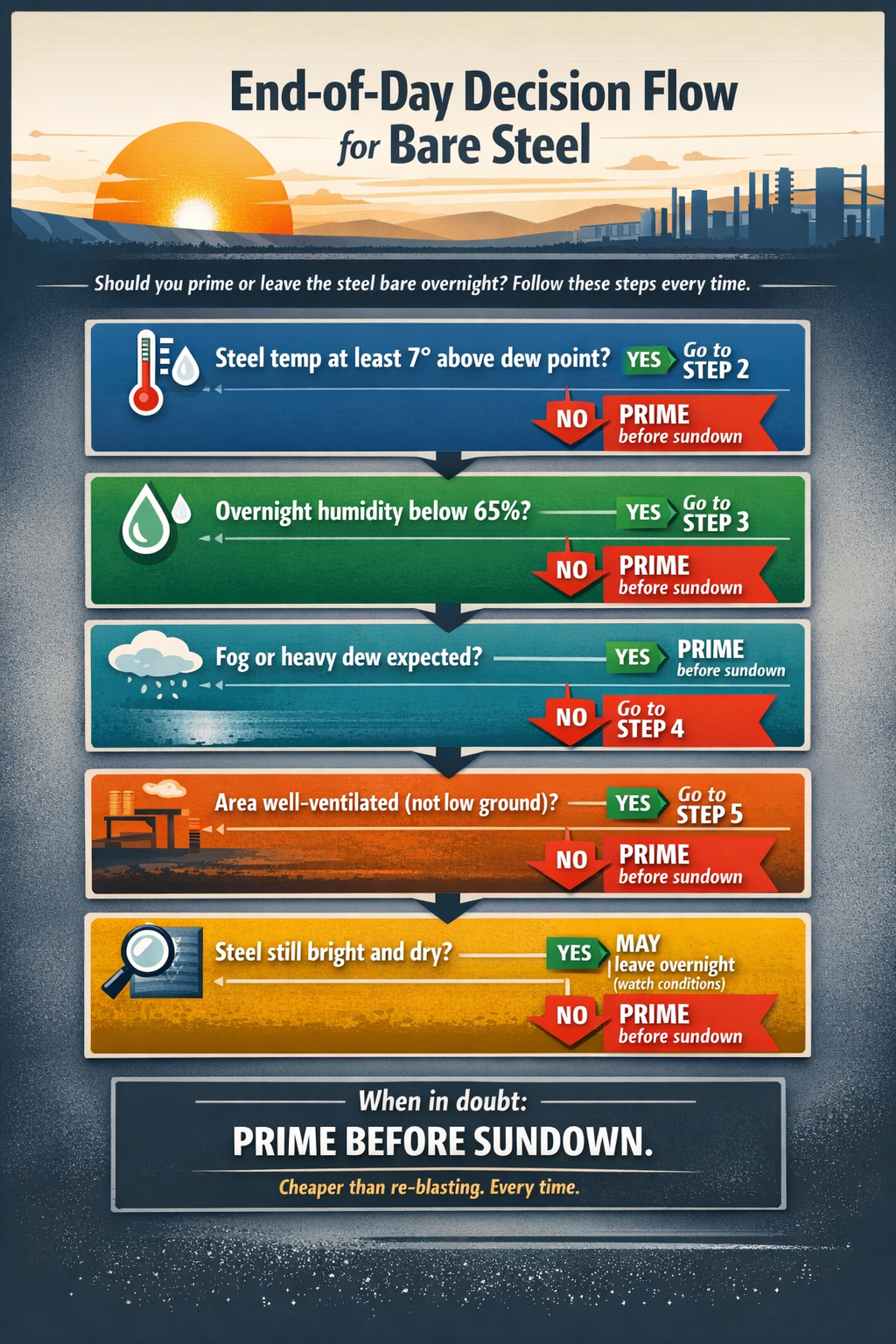
End-of-Day Decision Flow for Bare Steel
When a job runs long, this is the simple end-of-day decision process blasters should follow before leaving bare steel exposed overnight:
Step 1: Check Dew Point Spread
Is the steel temperature forecasted to stay at least 7°F above dew point overnight?
Yes → go to Step 2
No → prime before sundown
If you don’t know the steel temperature, assume it will cool faster than the air after sunset.
Step 2: Check Overnight Humidity
Is overnight humidity expected to stay below ~65%?
Yes → go to Step 3
No → prime before sundown
High humidity accelerates flash rust even without visible condensation.
Step 3: Check for Fog or Heavy Dew
Is fog, heavy dew, or morning condensation common at this site?
No → go to Step 4
Yes → prime before sundown
If fog is common, bare steel will change overnight. Period.
Step 4: Check Airflow and Exposure
Will the steel be in a well-ventilated area overnight (not low ground, not enclosed, not dead calm)?
Yes → go to Step 5
No → prime before sundown
Still air allows moisture to settle into the profile.
Step 5: Check Surface Condition Right Now
Is the steel still bright, dry, and unchanged at end of day?
Yes → you may leave it overnight with caution
No → prime before sundown
If the surface is already darkening, the window is closing.
Final Rule (When You’re Unsure)
If you would not be comfortable coating it right now, do not leave it overnight unprotected.
Primer is cheaper than re-blasting. Every time.
When a job runs long, this is the simple end-of-day decision process blasters should follow before leaving bare steel exposed overnight.
Why Weather-Related Failures Are Hard to Trace
When coatings fail due to weather effects, the root cause is often invisible by the time failure appears.
The blast profile is gone
The moisture is gone
The conditions have changed
The inspection records look acceptable
That makes weather-related failures easy to misdiagnose as paint quality or application error.
How Experienced Crews Work Around Weather
Crews who consistently avoid weather-related failures tend to:
monitor surface temperature, not just air temperature
track dew point throughout the day
adjust sequencing instead of forcing timelines
recognize when conditions are changing, not just when they are out of range
They treat weather as a variable to manage, not an obstacle to ignore.
The Bigger Picture
Weather is not an excuse. It is a constraint.
Blasting and coating systems do not operate in controlled lab conditions. They operate outdoors, on active sites, under changing environments. The more a project acknowledges that reality, the fewer surprises show up later.
Final Thought
Most weather-related coating failures do not come from extreme conditions. They come from borderline conditions that look acceptable until they aren’t.
Understanding how weather affects blasting and coatings turns guesswork into control.
Next up: Rust Grades Explained: Light, Moderate, and Severe
