
Common Myths About Media Blasting
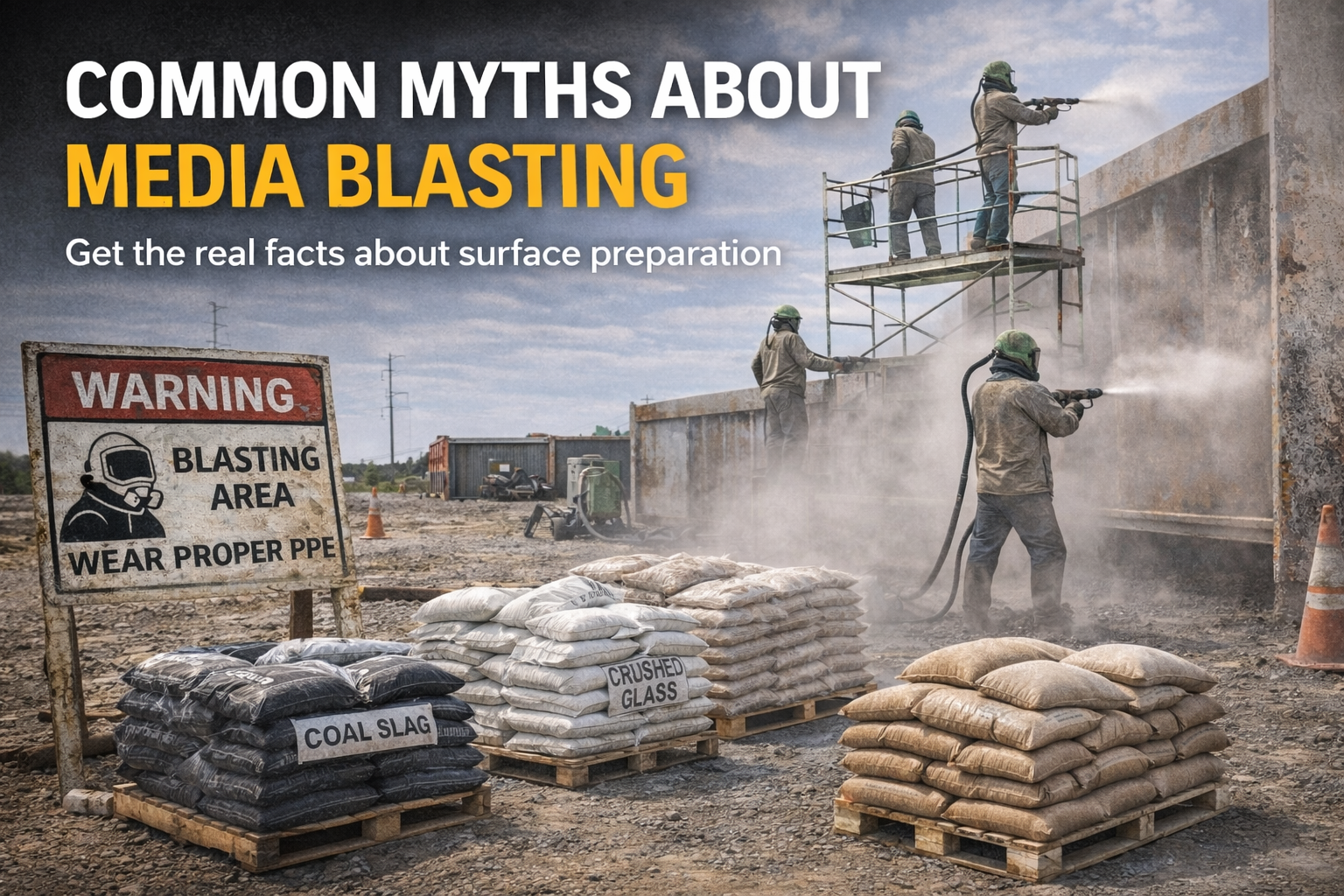
Media blasting has been around long enough that it has collected a lot of folklore. Some of it came from older methods. Some of it came from bad jobs. A lot of it came from people judging results by how things look instead of how they perform later.
These myths stick around because they sound reasonable. They just don’t hold up in the field.
Myth 1: “If It Looks Clean, It’s Ready for Paint”
This is the most expensive myth in surface preparation.
A surface can look bright and still be wrong.
Paint does not care about shine. It cares about:
surface texture
surface chemistry
contamination
consistency
A pressure-washed or lightly abraded surface can look perfect and still have:
no mechanical profile
embedded contaminants
moisture trapped in pores
Coatings don’t fail because the steel looked dirty.
They fail because the bond never formed properly.
Myth 2: “All Blasting Media Do the Same Thing”
Media is not interchangeable.
Crushed glass, coal slag, garnet, soda, and specialty abrasives:
fracture differently
cut differently
leave different profiles
behave differently on the same surface
Two blasters can remove the same paint with different media and leave behind very different surfaces. One may be ideal for the coating system. The other may shorten its life.
Media choice is part of surface prep, not just a consumable.
Myth 3: “Higher PSI Means Better Prep”
Higher pressure means more impact.
It does not automatically mean better surface condition.
Too much pressure can:
over-profile the steel
thin the coating at peaks
increase flash rust risk
warp thin material
waste media
Too little pressure can:
leave rust in pits
smear coatings instead of removing them
create uneven texture
The goal is not maximum force.
It is appropriate force for the surface and coating system.
Myth 4: “Blasting Is the Same Indoors and Outdoors”
Environment changes everything.
Inside blasting means:
slower work
worse visibility
higher containment needs
heavier cleanup
more PPE
more time per square foot
Outside blasting means:
wind
weather
contamination risk
sun and shade temperature swings
Same substrate. Same coating. Very different job.
That’s why inside and outside work are often priced differently and behave differently.
Myth 5: “Rust Is Rust”
Rust comes in stages.
Light surface oxidation behaves very differently than deep pitting and scale. Treating them the same leads to:
under-prep on severe rust
over-prep on light rust
wasted time
poor coating performance
Rust grade determines:
how aggressive blasting must be
how much profile is needed
how much coating thickness is required
what realistic service life looks like
Ignoring that is how expectations get disconnected from reality.
Myth 6: “Dustless Blasting Means No Dust”
Wet blasting reduces airborne dust.
It does not eliminate it.
It also introduces:
slurry
runoff
flash rust risk
cleanup challenges
Wet blasting solves specific problems:
fire risk
warp risk
dust-sensitive environments
It is not a universal upgrade.
It is a situational tool.
Myth 7: “Blasting Ends When the Nozzle Stops”
Surface prep does not end when blasting stops.
What happens next matters:
how long bare metal sits
what the weather does
whether contaminants return
how the coating is applied
Many failures blamed on blasting actually happen after blasting, when:
moisture condenses
dust settles
delays creep in
surfaces change
Blasting creates opportunity.
Everything after determines whether that opportunity is used or wasted.
Myth 8: “Specs Guarantee Results”
Specs define minimums.
They do not guarantee outcomes.
Two jobs can both meet spec and perform very differently depending on:
rust severity
geometry
coating choice
environment
application quality
Specs protect contracts.
They do not automatically protect assets.
Performance lives between the lines.
Why These Myths Don’t Die
These myths survive because:
blasting looks simple from the outside
failures take time to appear
causes are hard to trace backward
people judge by appearance instead of durability
By the time something peels, blisters, or flakes, the surface prep is long gone.
What Actually Matters
Media blasting works when:
the surface condition is understood
the media matches the task
pressure matches the substrate
environment is managed
coating compatibility is respected
It fails when:
appearance replaces preparation
speed replaces control
assumptions replace inspection
Final Thought
Media blasting is not magic, and it is not guesswork.
It is a physical process tied to chemical outcomes.
Most problems don’t come from blasting itself.
They come from believing one of these myths instead of the surface in front of you.
Next up: Why OSHA, EPA, and Silica Rules Matter to You
